- Published on
Why Many Project Ideas Never Reach Production
- Authors

- Name
- Owano Canol
- @owano-canol
The Idea Cemetery
Every developer knows the feeling. A sudden flash of inspiration. A quick sketch on paper or a note on the phone. A new repository created with excitement.
The future looks bright. Weeks (sometimes days) later the repository is silent. Features half-built. Bugs never investigated. Motivation quietly disappeared.
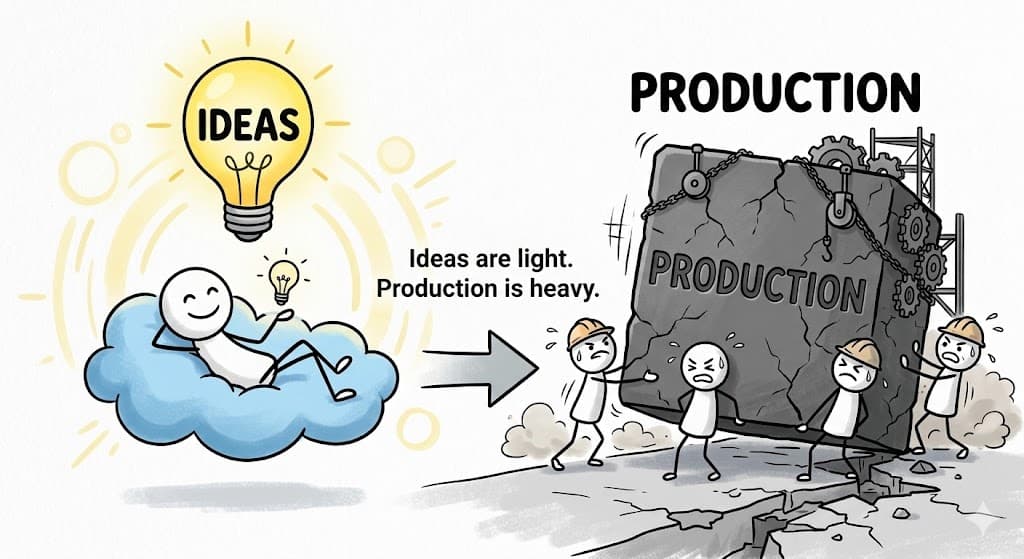
This pattern repeats thousands of times every day.It is not laziness.It is physics. Ideas are light. Production is heavy.Ideas live in diagrams. Production lives in machinery. Ideas are full of possibility. Production is full of responsibility.The distance between the two is much longer than most people expect.
Complexity Creeps In Like Weather
Early prototypes are dangerously encouraging.
A login page works. A dashboard renders data. Everything flows in happy little loops.Then complexity arrives — quietly at first.
Edge cases multiply. Authentication suddenly matters. Deployment starts failing in strange ways. Users behave in ways no diagram ever predicted. What was once a small script becomes an ecosystem. Ecosystems require care. Care requires time. When complexity grows faster than available time and attention, the project quietly stalls. This is not failure. This is arithmetic.
The Myth of the Perfect Start
Many believe a project must begin perfectly. Clean architecture from day one. Complete documentation. Elegant, future-proof code. Reality has other plans. Projects almost always begin messy. They evolve through iteration.
Early decisions will be wrong. Requirements will change. Assumptions will break. The goal is not perfection at the beginning.The goal is progress.Code can be refactored. Architecture can be improved. Ideas can be reshaped. But nothing can be improved if it never leaves the idea stage.
Scope Is a Silent Assassin
Ambition is beautiful. Unbounded ambition is dangerous. Feature lists grow quietly:
- authentication
- analytics
- notifications
- multi-tenancy
- AI integrations
- custom reporting
- dark mode
- mobile responsiveness
- admin panel
Each new item increases surface area.Each dependency adds another point of failure. Before you realize it, the project is no longer a tool — it’s a skyscraper built on sand.
Better approach:
Start very small.
Solve one real problem well.
Ship it.
Gather feedback.
Expand only where value is proven.
Production systems grow like trees, not rockets.
Roots first.
Height later.
Time and Life Happen
Developers are human beings.
Students graduate.
Jobs change.
Relationships deepen.
Families grow.
Health issues appear.
Responsibilities shift.
Side projects must compete with life.
The energy that once fueled late-night coding sessions gets redirected. This is not weakness. This is reality. Projects that survive do so because they adapt. Some become light hobbies. Some pause for months or years. Some shrink into something smaller but genuinely useful.
Not every idea must become a full product. Value exists even in the learning.
The Middle Is the Hardest Part
Beginnings are exciting.
Endings are satisfying.
The long middle is where most projects die.Progress feels slow. Bugs keep appearing. Motivation fades. Doubts grow louder.
This is normal.
The antidote is discipline over inspiration.
Small daily (or weekly) actions compound:
- Fix one bug
- Write one test
- Ship one tiny improvement
Momentum is fragile but powerful. Over time the middle becomes manageable. The project either reaches production or teaches valuable lessons. Both outcomes are worth something.
Technical Debt and Maintenance
Quick hacks feel productive in the moment. They often become expensive later. Technical debt accumulates silently:
- Undocumented magic numbers
- Brittle third-party integrations
- Assumptions that no longer hold
- Tests that were never written
Eventually maintenance becomes harder than creation.
This is why production systems demand ongoing care.
Not because perfection is required —
but because reliability is respect
for users
and for future developers
(including future you).
Product-Market Fit (Even for Side Projects)
A system can be technically brilliant and still unnecessary.
Real value comes from solving problems people actually have:
- It saves time
- It saves money
- It reduces pain
- It creates delight
Projects that ignore real needs usually struggle to survive. Engineering skill is important. Problem selection is equally important. Production is not just about code.It is about impact.
What Actually Works
The projects that reach production tend to share the same patterns:
- Ruthlessly clear scope
- Incremental delivery (ship early, ship often)
- Frequent feedback loops
- Just enough documentation
- Automated tests where it hurts most
- Willingness to iterate and kill features
They evolve. They survive imperfection. They prioritize users over ego. Production is a journey, not a moment.
Lessons
- Ideas are cheap. Execution is expensive.
- Complexity must be managed deliberately.
- Small, consistent progress beats heroic effort.
- Life influences priorities — that’s okay.
- Not every idea must succeed.
- Every attempt teaches something valuable.
Failure is not final.It is data.Knowledge compounds.Future projects benefit.
Moving Forward
If a project stalls, pause and ask:
- What is the smallest useful thing I can ship?
- Which assumptions are probably wrong?
- What can be simplified or removed?
- What real feedback exists?
Progress often begins with reduction, not expansion. Strip away everything non-essential. Solve the core problem.Then grow carefully.Ideas deserve respect.
But production requires work.
Between the two lies the real craft of software development.Keep building. Keep learning. Keep iterating. Even when it’s hard.Especially when it’s hard.